
EPA 2027 Is Coming - Do I Pre-Buy Now, or Wait and Hope?
Author
Richard Kemner
Date Published

EPA 2027 Is Coming. Do I Pre-Buy Now, or Wait and Hope?
A straight-talk look at what's driving 2027 truck prices, why the warranty number is telling us something important, and what it means for your fleet planning over the next 18 months.

Every customer I've talked to in the last 60 days has asked me some version of the same question: "Richard, do I pre-buy a 2026 truck now, or do I wait for the 2027s?"
There's no clean answer. But there's a clear way to think about the answer — and one specific data point that's telling us more than the press releases are. Let me walk you through it.
First, the facts as of today
EPA's 2027 heavy-duty NOx rule still takes effect January 1, 2027. The standard cuts allowed NOx emissions by about 82 percent versus today's trucks.1 Every major OEM — Cummins, Volvo, Mack, Detroit, International, PACCAR — has now publicly committed engines for it. Order banks for the Volvo D13 and Mack MP13 open in August 2026; Detroit Gen 6 starts production in January 2027.
Don't confuse this rule with the May 15 EPA announcement delaying light- and medium-duty Tier 4 standards to MY2029.2 That's a different program. The 35 mg/hp-hr heavy-duty NOx limit is not being repealed.
One important caveat — Reuters reported May 5 that EPA is preparing a draft rule revision (NPRM) expected in late June 2026.3 Industry reporting says the 35 mg NOx limit stays, but EPA may soften the new warranty and useful-life rules that have driven up 2027 truck pricing. If you have a major order pending, that NPRM is worth watching before you sign.
The warranty number is telling us something
Here's the data point I want every customer to understand. Under the current rules, an emissions-system warranty is 100,000 miles. Under EPA 2027, that warranty jumps to 450,000 miles. The defined useful life of the engine goes from 435,000 miles to 650,000 miles.4
What changed on paper
Now think like a manufacturer. If I'm Cummins or Detroit and the government just told me I have to warrant an emissions system — one of the least reliable parts of a modern diesel — for 4.5 times longer than I do today, what do I do? I price the risk in. Every DPF failure, every DEF sensor, every SCR module, every EGR cooler that fails between 100,000 and 450,000 miles is now my problem, not the customer's.
That's exactly what's happening. Industry estimates for the 2027 sticker premium range from $8,000 to $25,000 per truck, with most vocational analysts landing in the $15,000–$20,000 range for refuse and roll-off configurations.5 ACT Research said in February that those higher prices are now "effectively locked in" even with regulatory uncertainty.6
The thing I want you to sit with: that premium is not only the cost of new hardware. The 48-volt heaters to keep SCR catalysts hot during idling, the dual-SCR modules, the extra sensors — those are real. However. they only account for a fraction of the increase. The bulk of the premium is the OEMs pricing in repair risk over the next 450,000 miles. That tells you exactly how confident they are in the new aftertreatment systems. Not very.
Wait or pre-buy? The honest tradeoffs
Every fleet’s route profile and capital cycle are different. To help you weigh your options for the upcoming build cycles, here is how the business math stacks up for both strategies:
Pros
- Known quantity. The X12, X15, DD15, MP8, D13 have been on the road for years — we know their failure modes, service costs, and which parts wear first.
- Lower acquisition cost. $8K–$25K less per truck is $80K–$250K saved on a 10-truck order.
- Body builders are ready today. Heil, McNeilus, New Way, Galbreath all have current chassis specs nailed — no surprises on hoist clearance, PTO routing, or aftertreatment packaging.
- Residual value upside. The 2006 pre-EGR Macks and 2009 pre-DPF Petes held value for a decade. A clean 2026 has a good shot at the same story.
- Drivers know the trucks. Techs trained, fleet software configured, parts inventory right.
Cons
- Build slots are tight. Wait until November to decide and you may not get a 2026 slot at all.
- Older emissions hardware. Today's DEF/DPF/SCR still causes downtime — you're buying a known problem, not a problem-free truck.
- Not future-proof. Pre-buying delays the transition learning curve; it doesn't eliminate it.
Pros
- Cleaner emissions. 82% NOx reduction — a better story for municipal customers and ESG-conscious haulers.
- Longer warranty coverage. If the systems hold up, 450K miles of emissions warranty instead of 100K — the OEMs assuming repair risk you used to carry.
- Potential fuel-economy gains. Mack claims +3% on the MP13; Detroit and Volvo claim similar. On 25,000 miles a year, that's real.
- Modern electronics. Better diagnostics, predictive maintenance, telematics integration.
Cons
- Unproven reliability First-generation aftertreatment technologies traditionally experience higher initial fault rates and unexpected field bugs.
- Higher initial acquisition cost. Expect an extra $8,000 to $25,000 per chassis on new orders.
- Unknown body-builder integration. Body mounting, PTO line routing, and frame clearances may require modified engineering specs.
- Reliability is a question mark. The warranty pricing tells us the OEMs are nervous. We can hope — we can't yet prove.
What happens to pre-emission truck prices

Look at the used market today. A clean, well-maintained pre-EGR Mack from 2006 or a pre-DPF Peterbilt from 2009 still pulls strong dollars two decades later. Why? Because the market has voted on reliability. Those trucks proved themselves, and proven reliability sets the price.
Here's what I expect to happen with current pre-2027 chassis prices: they go up, not down. As 2027 build slots tighten and customers see the warranty-driven premium on new trucks, demand for clean late-model 2024–2026 units will firm up. We saw exactly this pattern in 2007 and 2010 — every prior emissions transition has produced a 3–5 year window where pre-rule trucks held a meaningful price premium in the used market.
If you own a fleet of 2024–2026 trucks today and you take care of them, that value is going to hold. And if you're sitting on the fence about pre-buying, just understand that the 2026 you buy in August at $X is likely worth somewhere close to $X for the next two to three years on the used market — provided you keep the maintenance records clean.
Can we trust the 2027 engines?
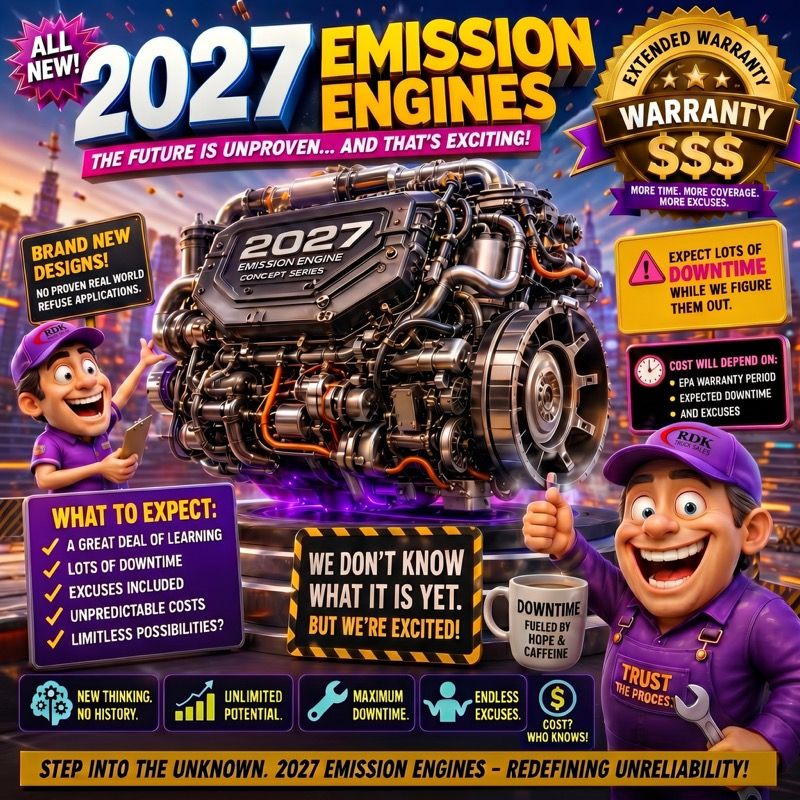
Honestly? We don't know yet. As of today — May 18, 2026 — there is not a single 2027-compliant heavy-duty engine in a paying customer's fleet. Not one. Every truck the OEMs have shown is an engineering or validation unit. There is no real-world refuse-route data, no roll-off duty-cycle data, no cold-start data outside controlled environments.
The new aftertreatment systems are also more complex than what we run today. The Cummins X10 uses a 48-volt electrical system to heat its emissions components quickly during cold starts — useful for an over-the-road truck, but unproven on a refuse truck that spends its life at idle and low load. Volvo and Mack are running dual-SCR modules with electric heaters. Detroit went the other direction with a pre-SCR architecture that skips the 48V system altogether.
Three different design philosophies. Three different bets. All launching in the same six-month window.
We can hope all three architectures prove reliable over time. We can hope the warranty premium is just nervous OEMs over-pricing the risk. But if these manufacturers are building that much cost into the sticker to cover a 450,000-mile warranty obligation — what are they telling us about the reliability they expect? That's a question worth asking your dealer rep directly.
So what should you actually do?
The Bottom Line
2027 emissions are coming. The 35 mg NOx limit is staying. But the warranty number and the sticker premium together are telling us a real story: the truck makers themselves are pricing in significant reliability uncertainty. That doesn't mean the new engines will fail — it means even the people building them aren't sure yet.
For most of my refuse and roll-off customers, my recommendation is the same as it was in 2006 and 2009: pre-buy what you need for the next 24 months, then pilot the new tech carefully before you commit your whole fleet to it. Watch the late-June EPA rule revision. And keep your 2024–2026 trucks running clean — that fleet is going to be worth more than you think.
The moment a real 2027 truck hits a real refuse route, I'll let you know how it's running.
I'm watching the order banks, the spec sheets, and the first customer deliveries every week. Until then — call me, and we'll spec your next order around what you actually need, not what a press release says you should want.
Richard KemnerFounder, RDK Truck Sales · Tampa, Florida
Call (813) 241-0711Sources
- Cooper's KW — EPA 2027 standards overview.
- EPA — Tier 4 light/medium-duty delay, May 15, 2026.
- Transport Topics — EPA 2027 NOx draft NPRM.
- Bergey's — warranty & useful-life changes.
- Summit Bodies — vocational truck cost estimates.
- Autocar / ACT Research — 2027 truck pricing analysis.

EPA 2027 emission standards could add $20,000–$30,000 to every new refuse truck. Here's what fleet managers should know before their next purchase.

RDK Truck Sales reports from Work Truck Week 2026 on the 2027 emissions changes and new 48V-heated DOC/DPF/SCR systems for refuse and roll-off trucks.

Weighing lease vs. purchase for your refuse trucks? See how RDK's 3-year lease eliminates warranty disputes and unpredictable repair costs.